(updated )
How to Become Prime Minister Without Disturbing the Bond Market
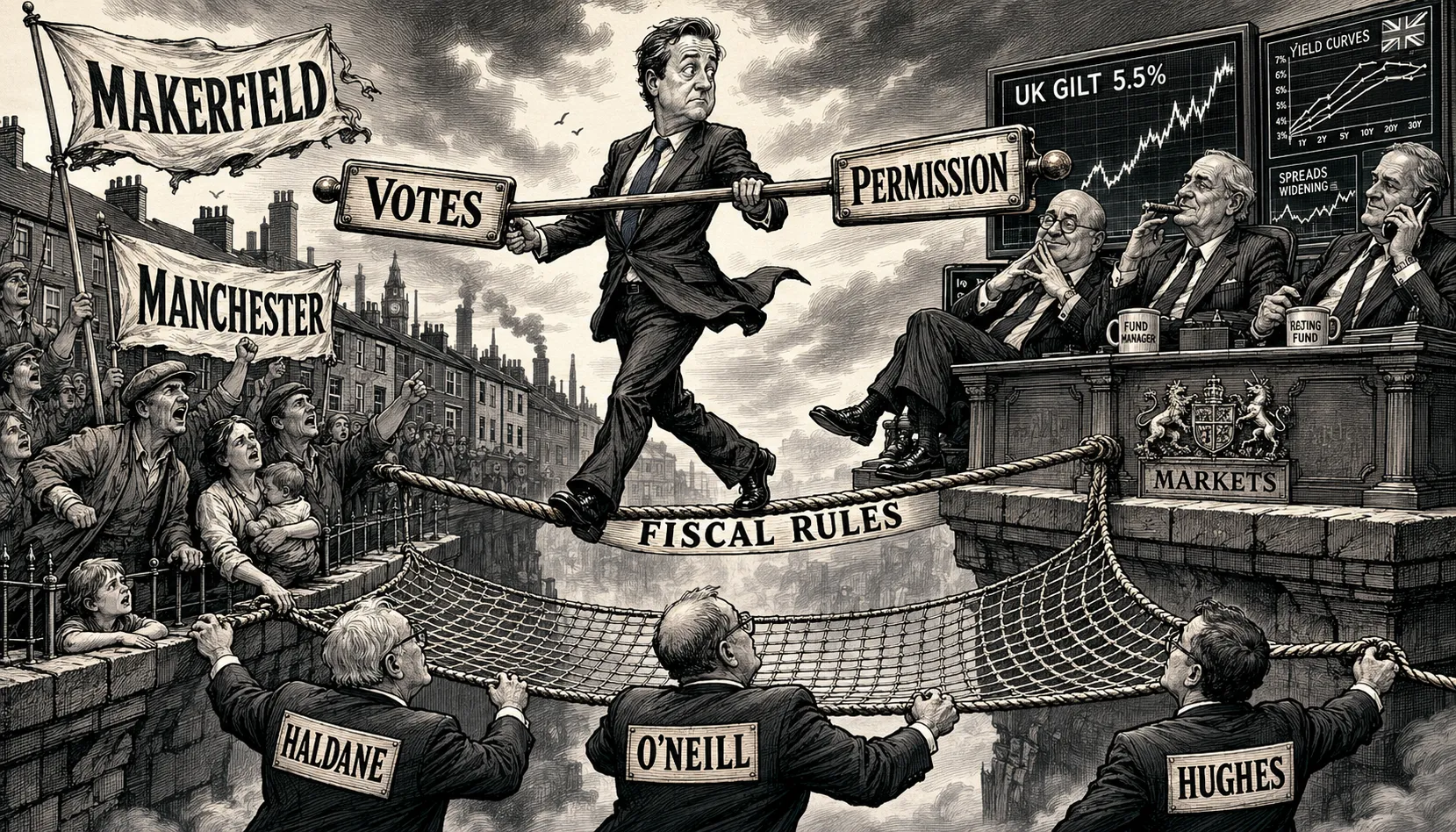
Andy Burnham has the votes, the unions, and the popularity. But none of it matters without permission from the only constituency that selects British prime ministers: the gilt market.
“Politics is the gentle art of getting votes from the poor and campaign funds from the rich, by promising to protect each from the other.” — Oscar Ameringer, socialist editor and organizer (1870–1943)
The British variant: politics is the gentle art of getting permission from the gilt market and votes from the electorate, by promising to serve each — and defaulting to the one that can destroy you faster.
Let me tell you how this works. You want to become Prime Minister. You have the votes. You have the unions. You have the personal popularity — polls say you’re the only major politician in the country with positive approval ratings. You win a by-election with an increased vote share, and Labour members prefer you over the incumbent by 62%.
None of it matters. Because you haven’t spoken to the only constituency that selects British prime ministers.
So you hire a team of economic advisers. Not any advisers — advisers the bond market knows. A former Bank of England chief economist. A former Goldman Sachs chief economist who served as a Tory Treasury minister. The former chair of the Office for Budget Responsibility who now works at a hedge fund. You present them to the financial press. You pledge to follow the existing fiscal rules. You signal, in every way a grown-up can signal without saying it out loud, that you will not threaten the interests that lend money to the British state.
Then, and only then, are you permitted to govern.
This is the story of Andy Burnham. It is also the story of how British democracy actually works.
The Two Constituencies
Every British prime minister serves two constituencies.
Constituency A votes. They live in Makerfield and Mansfield and Manchester. They want buses that run on time, hospitals that treat them, a government that doesn’t treat their region as an afterthought. They elect MPs. They think this is how power works.
Constituency B lends. They manage bond portfolios in London, Singapore, and New York. They hold £3 trillion of UK government debt — 31% of it in foreign hands. They do not vote in British elections. They do not need to. They set the price of British borrowing. And the price they set determines what any government — Labour or Conservative, Starmer or Burnham — can actually do.
When the two constituencies conflict, Constituency B wins. Not because it is larger. Not because it is more legitimate. Because it can withdraw its financing, and a government that cannot borrow is a government that cannot govern. The bond market is not an audience. It is a veto.
Andy Burnham understands this. Everything he has done in the six months leading to his leadership bid is an exercise in managing the contradiction. Let me show you the mechanism.
How Burnham Secured Permission to Rule
The problem
By June 2026, Burnham had everything Constituency A could give him:
- Personal popularity: Described as “the only major politician in the country who enjoys positive favourability ratings.”
- Party support: 62% of Labour members preferred him over Starmer, with 43% naming him first choice for leader — five times the support of Wes Streeting at 9%.
- Union backing: Unite and Unison had already contributed £20,000 to his campaign and were calling for a return to “Labour values.”
- MP allies: A network spanning the Tribune soft left (Louise Haigh, Clive Lewis, Rachael Maskell), the party machinery (deputy leader Lucy Powell, former Corbyn adviser Anneliese Midgley), and even some in government who feared Starmer was a dead man walking.
He had won the Makerfield by-election on June 18, 2026, with an increased vote share. His allies talked openly of a “coronation.”
But Constituency B was watching. And Constituency B was nervous.
The numbers: thirty-year gilt yields had risen from 4.5% to 5.5% over the previous year, peaking at 5.7% in September 2025 — the highest since 1998. In May 2026, the UK borrowed £23.3 billion, nearly a third more than the previous May. Debt interest payments hit £11.7 billion in a single month — the highest May figure ever recorded. Total government debt was on course to surpass £3 trillion within months.
The Institute for Fiscal Studies put it bluntly: “The government now finds itself in the unenviable position where the reaction of the bond market is increasingly becoming the constraint on fiscal policy.”
Burnham had a history of saying things that made the bond market uncomfortable. He had argued that governments “should not be in hock to bond markets.” He had positioned himself as the man who stood up to Westminster on behalf of the North. His brand was populist, regional, and vaguely insurrectionary.
None of this would survive contact with the gilt market. So it didn’t.
The conformity bath
In the weeks before his by-election, Burnham assembled his economic advisory team. The selection is the story. Look at who he chose — and who he chose to be seen choosing:
Andy Haldane — former Chief Economist of the Bank of England (2014–2021), now CEO of the Royal Society of Arts. Haldane has said the case for changing UK fiscal rules is “overwhelming” — specifically to allow more government investment for growth. He has urged the Bank against interest rate rises. He has set out how war bonds for defence spending could work. He is the most prominent Establishment voice arguing that the rules should change — from inside the room, with the right language, at the right pace.
Jim O’Neill (Lord O’Neill of Gatley) — former Goldman Sachs chief economist, former Tory Treasury minister under George Osborne, crossbench peer. Architect of the “Northern Powerhouse” concept. O’Neill has called UK fiscal constraints “petty and arbitrary.” He recently wrote a blueprint for economic growth endorsing a bond-and-equity-market rally, a construction boom, and the “political dividends” that come with broad-based gains to living standards. A Goldman Sachs economist turned Conservative minister, now advising a Labour leadership challenger. The revolving door is not hidden. It is displayed as a credential.
Richard Hughes — former chair of the Office for Budget Responsibility (2020–2025), the fiscal watchdog itself. Hughes resigned from the OBR after it accidentally published Rachel Reeves’s budget early. He is now senior economic adviser at Taula Capital, a London-based fund manager. The man who oversaw the fiscal rules is now advising the politician who wants to replace the government the rules constrain. Hughes told lawmakers in January 2026 that Reeves’s fiscal rules do little to bring borrowing under control and mean “righting the fiscal ship after a shock happens much more slowly.” The watchdog has joined the challenger.
Carys Roberts — former executive director of the Institute for Public Policy Research, a centre-left think tank. The soft-left policy infrastructure, rounding out the quartet.
This is not a team of economists. This is a signalling device. Every name is a message to the gilt market: I am safe. I know who you are. I know what you require. I will not deviate.
Rupert Harrison — senior adviser at PIMCO, one of the world’s largest bond investors, and former chief of staff to George Osborne — called them “all extremely credible.” That is the approval that matters. Not the voters. Not the unions. The bond manager who used to work for the architect of austerity.
What Burnham has already conceded
Before he has even launched a leadership challenge, Burnham has modified or softened his positions on:
- Fiscal rules: From “governments should not be in hock to bond markets” to “I will follow the existing fiscal rules.”
- Bond market rhetoric: From populist critique to Haldane-mediated talk of “responsible reform.”
- EU relations: Softened to avoid spooking business.
- Immigrant benefits: Tightened.
The Telegraph noted these shifts have “left some of his supporters with doubts about his exact political stance.” The doubters are correct to doubt. The shifts are not deviations from the project. The shifts are the project. They are the price of admission to the only constituency that can veto his premiership before it begins.
Susannah Streeter, chief investment strategist at Wealth Club, translated the signal for the public: investors have “priced in the likelihood of a Labour leadership challenge” and are reassured because “Burnham has promised to be more cautious about spending by largely sticking to fiscal rules.”
The financial press is explicit about what is happening. Bloomberg: “The market reaction to any change in fiscal rules could depend as much on timing and presentation as substance — plus the person Burnham appoints as chancellor.” The market will judge. The market will respond. The government will adjust. This is not speculation. This is the structure, described by its participants.
The OBR: How Market Discipline Becomes Technocratic Necessity
The mechanism that translates Constituency B’s preferences into government policy is the Office for Budget Responsibility. It was created by George Osborne in 2010 as part of the austerity architecture. Its function is to assess whether government fiscal policy is “sustainable” — defined as consistent with declining debt-to-GDP over the forecast horizon.
When the OBR says your spending plans are unsustainable, gilt yields rise. When gilt yields rise, your borrowing costs increase. When your borrowing costs increase, you must cut spending to meet the fiscal rules. The OBR’s forecast becomes the reality it predicts. This is not a conspiracy. It is a design feature.
The rules Reeves bound herself with — and Burnham has pledged to follow — are:
- The stability rule: The current budget must be in balance or surplus by the third year of the forecast. Day-to-day spending must be covered by tax revenue. Borrowing is permitted only for investment.
- The debt rule: Public sector net financial liabilities must be falling as a share of GDP by the third year.
- The welfare cap: Some types of welfare spending must remain below a pre-specified level.
These rules are not laws of nature. They are not in the British constitution — there is no British constitution. They are political choices, institutionalized to survive changes of government. Their function is to make market discipline appear as technocratic necessity. The politician does not say “the bond market won’t let me.” The politician says “the OBR forecast requires” or “fiscal responsibility demands.” The constraint is depoliticized. The violence of the market — its capacity to withdraw financing and crash an economy — is rendered invisible, translated into the calm language of “sustainability” and “credibility.”
Burnham is not challenging this mechanism. He is hiring its former chairman.
Why Starmer Fell: The Vacuum Burnham Fills
To understand what Burnham represents, you have to understand what Starmer destroyed.
The numbers that broke a premiership
By November 2025, Keir Starmer was the most unpopular British prime minister since records began in 1977: 13% satisfaction, 79% dissatisfaction — a net approval of minus 66. His average net approval fell from +5% after the election to -46% within eighteen months. Labour suffered record losses in the 2025 and 2026 local elections. In January 2026, the Greens won the Gorton and Denton by-election — a seat Starmer’s NEC had blocked Burnham from contesting, preferring to lose to the Greens than open a path to a leadership rival.
The 10 abandoned pledges
Starmer ran for Labour leader in 2020 on a platform of 10 pledges designed to reassure the Corbyn-era membership. He then abandoned all of them:
Common ownership of rail, mail, energy, and water — gone. Ending outsourcing in the NHS and local government — gone. Abolishing the two-child benefit cap — gone, then partially reversed under extreme pressure. Free university tuition — gone. Tax hikes for the richest — gone. A compassionate immigration system — gone. A Green New Deal — gone. Restricted foreign arms sales — gone. Workplace democracy — gone.
And crucially: support for Palestinian rights.
The Palestine wound
This is the one that cut deepest — and not only among Muslim voters.
Starmer made “ending antisemitism in the Labour Party” the centrepiece of his leadership. The project meant expelling Jeremy Corbyn, suspending MPs who described Israel’s actions in Gaza as genocide, and maintaining staunch support for Israel through the first year of a war that killed tens of thousands of civilians.
The timeline:
- October 2023 – mid-2024: Starmer backed Israel’s “right to defend itself” without qualification. Labour suspended MPs Graham Jones, Andy McDonald, Azhar Ali, and Kate Osamor for comments about Israel’s conduct.
- February 2024: Starmer called for a “ceasefire that lasts” — months after the scale of destruction was undeniable, and only after the political cost of silence exceeded the cost of repositioning.
- March 2025: Foreign Secretary David Lammy stated that Israel’s blockade of Gaza was a “breach of international law.” Starmer’s office publicly rejected Lammy’s statement — then said it was up to Lammy whether to apologize.
- September 2025: The British Palestinian Committee published “Party to Genocide” — a one-year review of Labour government complicity.
This was not incompetence. It was a calculation: the Muslim vote — concentrated in urban constituencies, often working-class, historically Labour — could be taken for granted. They had “nowhere else to go.” The Greens and independents proved that wrong. But more than the electoral damage, Palestine crystallized the deeper truth about Starmer’s project: it was not on anyone’s side except the institutions. It did not stand for anything except its own continuation.
The economic translation
Rachel Reeves entered office promising not to raise taxes while delivering Labour’s spending commitments. The math was impossible.
Her first budget scrapped winter fuel payments for pensioners — an immediate, visceral betrayal of a vulnerable constituency. She froze income tax thresholds — fiscal drag, a stealth tax on workers. She increased property and council tax. The OBR deemed her measures inflationary. Gilt yields spiked. The rules she had chosen to bind herself had bound her.
The result: a Labour government that governed like a Conservative one, cutting welfare while the bond market watched — and demanded more. By June 2026, a government elected on a promise of change had delivered: record unpopularity, record borrowing costs, and a population that could not tell you what Labour stood for because Labour could not tell them.
This is not merely a cautionary tale. It is an empirical refutation. Starmer’s government tested the proposition that Labour values and market-imposed fiscal constraints can coexist in productive tension — and the proposition failed. The rules did not create space for progressive outcomes. They foreclosed them. The OBR did not provide technocratic neutrality. It provided transmission — translating bondholder preferences into the language of sustainability and credibility. Practice has already delivered its verdict: the architecture makes Labour govern like Tories. The burden on Burnham is not to be more popular than Starmer. It is to explain why his outcome would differ when his architecture — the same fiscal rules, the same advisory class, the same structural dependence on foreign-held debt — is identical.
The Contradiction, Named Precisely
Here is where the abstraction meets the fact.
Andy Burnham is popular because he presents himself as the antidote to all of this. The “King of the North” who stood up to Boris Johnson’s COVID lockdowns. The mayor who brought buses back into public ownership. The man who says politics should “work properly for people.” He is running as the candidate of Constituency A — the people the system has left behind.
And to become acceptable to Constituency B — the people who lend to the system — he has hired their representatives. Haldane. O’Neill. Hughes. The former Bank of England chief economist. The former Goldman Sachs economist turned Tory minister. The former OBR chair turned hedge fund adviser. He has pledged to follow their fiscal rules. He has softened every position that might make them uncomfortable.
This is not hypocrisy. This is the job. The Ameringer principle, British edition: get votes from the regions and permission from the gilt market, by promising to serve each. The promise is impossible. When the contradiction intensifies — when the bond market demands cuts that the electorate will not accept, when the fiscal rules require austerity that the “King of the North” was elected to oppose — the bond market wins. It wins not because it is more popular. It wins because it can withdraw its financing. And a government that cannot borrow cannot govern.
The tragedy — or the function — is that Burnham understands this and accepts it. He is not a cynic. He is a realist who has concluded that the only route to power is through Constituency B, and that power, once achieved, can still do some good within the constraints. Whether this is wisdom or self-deception is the question the next government will answer.
But the two-constituency model, for all its explanatory power, describes a symptom, not the generative mechanism. The deeper contradiction is not between voters and bondholders. It is between what the economy needs — functioning public services, regional investment, wage growth, the material conditions of Constituency A’s survival — and the financial architecture that subordinates those needs to the requirements of people who lend to the British state. The productive base and the financial superstructure are in conflict, and the superstructure dominates. Burnham is a secondary figure in a structural contradiction that precedes him and will outlast him.
This in turn raises a question about the nature of the contradiction itself. Burnham treats the two-constituency conflict as manageable within the existing framework — a matter of trusted advisers, careful language, Haldane-mediated reform. But if the rules that guarantee market confidence are the same rules that foreclose what voters are asking for, the contradiction cannot be managed. It can only be surrendered to, or broken. Burnham has chosen surrender before taking office. He calls it realism. History may call it something else.
But the structure is not ambiguous. The British political system is a two-stage selection process. Stage 1: win votes — Burnham has done this. Stage 2: win permission from the financial constituency — Burnham is doing this now. Stage 2 is not optional. Stage 2 is not corruption in the narrow sense — nobody is writing checks. It is structural. When you depend on foreign capital to fund your government, the preferences of foreign capital become the effective constitution. The fiscal rules are the codification of those preferences. The OBR is the enforcement mechanism. The advisory roster is the conformity bath.
The names change. The arithmetic doesn’t.
What to Say If You’re Asked
If someone asks you about Burnham’s leadership bid, here’s what you say. Keep it tight. Name the mechanism. Let the contradiction land.
“Burnham’s rise tells you how power actually works in this country.
He has the votes. He has the unions. He has the personal popularity — he’s the only major politician with positive approval ratings. But none of that matters unless he also has the confidence of the gilt market.
So in the weeks before his by-election, he assembled a team of economic advisers: Andy Haldane, the former Bank of England chief economist. Jim O’Neill, the former Goldman Sachs chief economist who served as a Tory Treasury minister. Richard Hughes, the former chair of the Office for Budget Responsibility who now works at a hedge fund. The signal is explicit: I am safe. I will follow the fiscal rules. I will not threaten the interests that lend to the British state.
Oscar Ameringer, the old American socialist, said politics is the gentle art of getting votes from the poor and campaign funds from the rich, by promising to protect each from the other. The British variant: get permission from the gilt market and votes from the electorate, by promising to serve both.
The promise is impossible. When the contradiction intensifies — when the bond market demands austerity that the voters were promised would end — the bond market wins. Not because it’s more popular. Because it can withdraw its financing. And a government that cannot borrow cannot govern.
Burnham knows this. His entire pre-leadership positioning is an exercise in managing the contradiction. He may govern with different language than Starmer. He may invest marginally more. But he will govern within the same constraints — because the gilt market does not negotiate. The arithmetic does not change when the personnel does.
The question is not whether Burnham is better than Starmer. The question is whether any prime minister operating within a system where the bond market holds veto power can deliver what the voters are asking for. The evidence so far says no.”
Sources
- The Guardian: “Burnham brings in top economists before possible leadership run,” June 18, 2026
- Bloomberg / Financial Post: “Burnham May Yet Rewrite UK Fiscal Playbook If He Becomes Premier,” June 2026
- Yahoo Finance: “Public borrowing surges ahead of Burnham leadership bid,” June 2026
- Washington Post: “Andy Burnham wins U.K. parliament seat, key step in bid to oust prime minister,” June 19, 2026
- The Nation: “Is This Man Britain’s Next Prime Minister?” July/August 2026
- BBC News: “Who is Andy Burnham? Returning MP who wants to be prime minister,” 2026
- Wikipedia: “Andy Burnham” — political career, leadership speculation
- Wikipedia: “Keir Starmer” — approval ratings, broken pledges
- Institute for Fiscal Studies: “The Budget and bond markets: when you’re in a hole, stop digging,” 2025
- Institute for Government: “Current UK fiscal rules,” 2026
- Office for Budget Responsibility: “Fiscal risks and sustainability,” July 2025
- House of Commons Library: “The UK’s fiscal targets,” CBP-9329, March 2026
- British Palestinian Committee: “Party to Genocide — Labour’s First Year in Government,” September 2025
- Oscar Ameringer, via Quotery and Goodreads — attribution confirmed
- Michael Parenti Political Archive — quotation verification