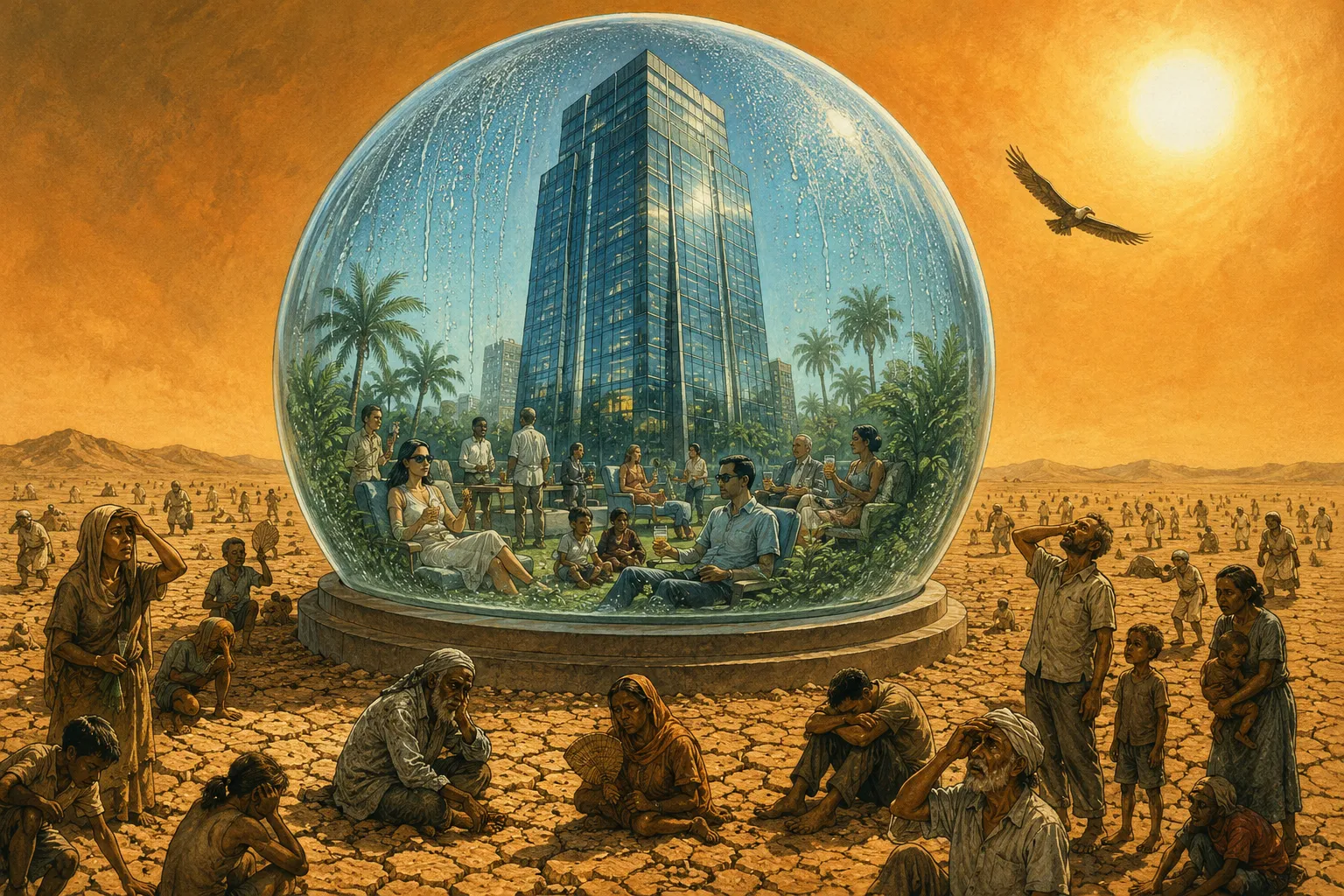
In the World but Not of the World: How Air Conditioning Privatised the Sky
Air conditioning was invented to stop paper from wrinkling, not to cool people. A century later it is the load-bearing wall of modern life — the machine that made the skyscraper, the mall, and the sealed car possible, and that now decides who survives the summer.
Air conditioning was invented to stop paper from wrinkling.
In July 1902 a twenty-five-year-old engineer named Willis Carrier installed an apparatus in the Sackett-Wilhelms printing plant in Brooklyn. The problem was not that the workers were hot. The problem was that the paper swelled and shrank with the humidity, and the ink would not register. Carrier’s machine blew air over chilled coils and held the shop at a steady 55 percent humidity — the cooling equivalent of melting 108,000 pounds of ice a day. He was not trying to comfort anyone. He was protecting a production process. The modern air conditioner, ancestor of every window unit and chilled tower on earth, was born as an instrument of capital, and the human body has been the afterthought ever since.
For two decades the technology never left the factory. It served textile mills, pharmaceutical plants, film processing — wherever the product, not the person, demanded a constant climate. Only in 1925, when Carrier cooled the Rivoli Theater in Manhattan, did capital discover it could sell cold air as a ticket. The air-conditioned interior was a paid experience before it was anything else, and in some sense it has stayed that way.
Call the thing by its real name: a machine for being in the world but not of the world.
The phrase is old. In the Gospel of John, Jesus prays that his followers be kept from the world while remaining in it. In the Sufi tradition, the doctrine of the perfect man — al-Insan al-Kamil, systematised by Ibn ‘Arabi and sung by Rumi — describes a person present in creation, active in it, yet not captured by it. Detachment there is a discipline of the soul, earned the way a mirror is polished. No one in that tradition imagined you could buy it by the ton of refrigerant. But that is what we did. The sealed tower, the refrigerated mall, the air-conditioned car: these are machines for being in the world but not of it — physically inside the climate, thermally immune to it, insulated from the consequences the comfort produces. Transcendence used to be a discipline. Now it is a product.
To see what this product actually is, watch what it moves. An air conditioner does not make anything cold. It is a pump, and what it pumps is heat: it takes the warmth out of your living room, concentrates it, and dumps it outside — on the street, in the faces of the people who cannot afford to be rid of it. The compressor adds energy to force heat uphill, out of a cool room into a hotter street, and for every unit of electricity it eats it moves three or four units of heat. It cools the indoors by heating the outdoors. That is not a side effect. It is the mechanism.
Everything modern life is proudest of is an artefact of this pump. The sealed glass skyscraper is a thermodynamic impossibility without it: a stack of glass under the sun is an oven, and the only reason the people inside do not cook is that a chiller plant somewhere is throwing their heat onto the pavement. The windowless shopping mall is a furnace full of bodies with no way for the heat to leave — unless a machine removes it. The closed car is the same trap at body scale: a few square metres of metal and glass will pass sixty degrees in minutes, and the driver survives only because the engine drives a compressor that pushes the trapped heat back out into the air the pedestrians breathe.
Dubai is what this looks like when it stops pretending. A city of three and a half million in a desert that averages forty-one degrees, it is not adapted to its climate; it denies the climate exists. Air-conditioned towers, an indoor ski slope, air-conditioned bus shelters, an entire public life migrated into refrigerated malls. The Dubai Mall, the Burj Khalifa, the metro — none of them carry their own cooling. They drink chilled water from central plants run by a state company, millions of tons of refrigeration piped under the sand. Lee Kuan Yew once called air conditioning the most important invention of the twentieth century, the thing that made tropical development possible. Dubai is the proof, pushed past parody: it made desert development possible.
Here is the trap, and it is exact. Air conditioning was sold as liberation from heat, but what it did was make it possible to build a world that cannot be survived without it. It did not answer a hostile climate; it permitted a hostile architecture, then sold itself as the only remedy for the hostility it had enabled. The porch, the shade tree, the cross-breeze, the courtyard, the thick wall — a thousand years of vernacular wisdom about living with heat — were deleted, and in their place rose the sealed box that requires a machine. We did not get air conditioning because we built skyscrapers. We built skyscrapers because air conditioning existed.
And the machine makes its own market. Every unit rejects heat into the city; the city grows hotter; the hotter city sells more units. We burn fossil fuel to generate electricity to run pumps that push heat outside, which warms the planet, which raises the temperature, which sells more pumps. The International Energy Agency expects the world’s stock of air conditioners to go from 1.6 billion to 5.6 billion by 2050 — ten new units sold every second for the next thirty years. Cooling is already the fastest-growing use of electricity in the built world, and by mid-century it will outrun data centres and electric vehicles alike. The “solution” to heat has become one of the leading drivers of heat. This is not a system malfunctioning. It is a system delivering exactly what a machine built to enlarge its own market was built to deliver.
Now ask who pays, because that is the question the brochures will not let you ask.
Air conditioning works. It cuts heat mortality by roughly eighty percent for those who have it. That is precisely what makes its distribution a map of who is expendable. Something like two and a half billion people live in heat without cooling today; on current trends, 3.2 billion by 2050. In the United States, nearly a fifth of very-low-income households have no air conditioning at all, and roughly half the population lives in a state with no protection against a summer utility shut-off. The people who die of heat, indoors, are old, alone, poor, and disproportionately Black, Indigenous, and Latino. The correct answer to “who pays?” was never “everyone equally.” It is the people who cannot buy the cold — and they pay in the only currency the machine accepts.
Europe is where the bill finally arrives home. European housing was built to keep heat in, not out: heavy masonry, small windows, no shading, no cross-ventilation, no cooling — a stock tuned for a climate that no longer exists. A forty-degree heatwave in a city built for twenty is not discomfort; it is lethal. The heatwave of 2003 killed around seventy thousand Europeans; the one in 2022, more than sixty thousand. So air conditioning is arriving in Europe not as luxury but as survival infrastructure — a vital tool for tens of millions who never needed it before. And it is arriving through the same old logic: a privatised split unit for those who can pay, an uncooled ward for those who cannot. The people least responsible for warming the climate are now the ones who must buy the machine to survive it, while the machine warms the climate further.
The through-line is enclosure. First we enclosed the land, then the factory, then the atmosphere itself — a private, billable microclimate. Air, the one thing left common to all, is now metered, owned, and distributed by income. The sky has been subdivided.
Here is what should settle the argument about whether it has to be this way. Every version of this technology that respects its neighbours is either collective or preventive — and neither is what the market defaults to selling. You can reject the heat into the ground or the sea instead of the street: Toronto’s deep-lake cooling, the seawater plants of the Gulf. You can recover the heat and use it to warm the building’s water, the way Scandinavian district energy couples cooling to heating so nothing is wasted. You can reject the heat to space itself, through materials that radiate it straight out of the atmosphere. You can shade, insulate, and reflect so there is less heat to pump in the first place. All of it exists. All of it works. But it is shared infrastructure and prevention, and the market sells the private split unit, because the private split unit externalises the heat and privatises the comfort. That is not an accident of engineering. It is a choice, made on behalf of people who were never asked, by people who profit from keeping the heat a commodity.
The Sufi who learned to be in the world but not of it did so by discipline, and it cost him nothing but himself. The rest of us now buy the same condition by the kilowatt-hour, and the price is paid by everyone outside the glass. The phrase has been reversed. Detachment was once a liberation from the world’s hold on you. Now it is an insulation from a world you are still, all the while, heating.