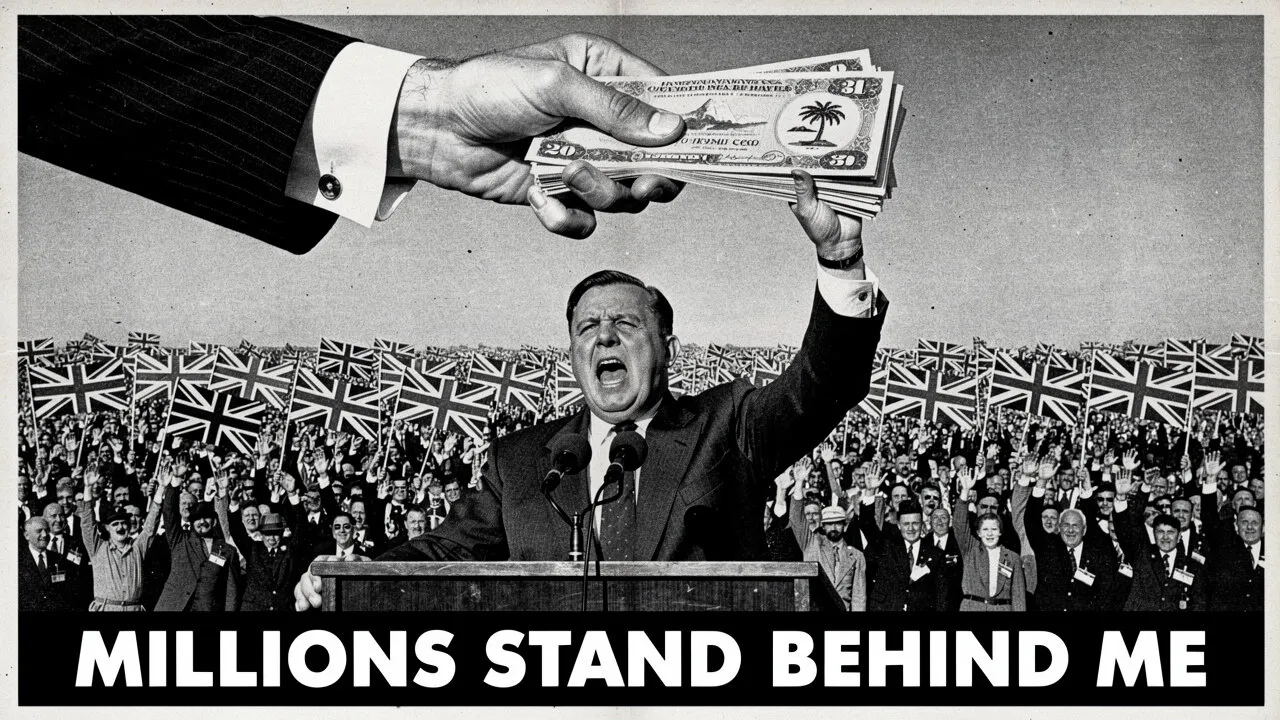
The Manufacture of a Movement: What Reform UK Is Actually For
Reform UK sells itself as an anti-establishment insurgency. Its money—offshore, ex-Tory, concentrated—tells a different story. The party is not an anomaly. It is the latest British instance of a recurring pattern: the demagogue founded on elite capital, the non-economic rallying flag used to hold a cross-class coalition together, the systemic effect of routing real grievance away from the ownership question. This is how reactionary movements get built—not by a conspiracy, but by an incentive structure that rewards the fragmentation of the producing class.
“Politics is the gentle art of getting votes from the poor and campaign funds from the rich, by promising to protect each from the other.” — Oscar Ameringer, socialist editor and organizer (1870–1943)
Reform UK asks to be understood as an insurgency. It runs against Westminster, against the establishment, against a political class it says has abandoned ordinary British people. Its founder-figure built his career on that posture — first as the face of the campaign to leave the European Union, now as the face of the party that promises to finish the job at home.
The money says something the posture does not.
Independent investigation into Reform’s finances has established a consistent picture. Reporting drawing on Electoral Commission records and Companies House filings finds that roughly three-quarters of the party’s donations since 2019 came from just three wealthy men, and that a large majority of its 2025 cash — one analysis puts it near four-fifths — is linked to businesses with offshore, tax-haven interests. Its biggest backers were, almost without exception, prior donors to the Conservative Party. Its treasurer has taken the fundraising operation offshore in the literal sense, courting the globally wealthy in Monaco and the Gulf to raise tens of millions. Its largest single donor holds foreign citizenship and business interests routed through low-tax jurisdictions, including a fuel-supply company that has held United States defence contracts. A party that presents itself as the enemy of the establishment is financed by the people who have owned the establishment for a generation.
The contradiction is worth naming, though on its own it stays a scandal, and scandals expire. What lasts is the structural question: why does this particular form — insurgent style, establishment money, a non-economic grievance raised as a flag — keep getting built? Not once, and not only here. The same shape recurs across countries and across decades. The demagogue is reborn again and again. Reform UK is the current British instance of a pattern, and the pattern is what deserves the attention.
Four roles a movement like this has to fill
Begin with a constraint. A party funded by the rich and voted for by the poor cannot make its central question who owns what. That question sets the funder against the voter, and the coalition falls apart on the first day. So the movement has to be organized around something else — something that unites the donor and the voter instead of dividing them. Everything that follows is a solution to that constraint.
Four roles get filled, whether by four people or, in some cases, by one.
The entrepreneur. A figure whose personal brand is separable from any party, whose success is measured by disruption to the existing order rather than by anything passed into law, and who can command attention at will. Reform’s founder-figure is the type in its pure form: the same man fronted the Brexit campaign and now fronts the party. The vehicle changes; the driver does not.
The donor. Somebody has to place the seed capital, and the placement works like a bet on a promising startup. Here the comparison to venture capital has to be handled with care, because it breaks in an instructive place. A venture fund diversifies — it spreads bets across many firms, expecting most to fail. Capital does not diversify like that across the political spectrum. It bets directionally, overwhelmingly toward parties that will never touch the ownership of the economy, because a party that will never touch ownership is, from capital’s standpoint, the safer asset. Nothing about that requires a conspiracy. A portfolio bias is enough, and the bias carries a class logic inside it.
The network-builder. Money and charisma do not become an institution on their own. Someone has to collate the vested interests — the financiers, the fundraisers, the friendly media figures, the think-tank staff who supply the language — and weld them into an organization. In Reform’s case this is visible in the treasurer’s role and in the offshore fundraising circuit that turns wealthy sympathy into an operating budget.
The flag. Finally, the movement needs a rallying issue, and by the logic of the constraint it must be a non-economic one. Immigration. Sovereignty. “Take back control.” National restoration. These issues are not chosen because they matter more than wages, rent, or who owns the workplace. They are chosen because they can hold a cross-class coalition together. “Take back control” unites the pensioner, the small trader, and the insecure worker. “Change who owns the surplus” splits that coalition along the exact line the movement exists to paper over. Ameringer’s epigram is the whole mechanism in one sentence: protect the poor from the rich and the rich from the poor, and take from each what they have to give — votes from one, funds from the other.
A machine with no one at the controls
The picture so far invites a lazy reading: that somewhere a room of powerful people designed this to fool the public. That reading is wrong, and it is worth being precise about why, because the precision is the argument.
No one has to design it. The donor funds the vehicle that already works. The entrepreneur assembles the coalition that can actually win. The voter answers the one party that at least names his grievance out loud. Each actor behaves rationally from where he stands, and the systemic result assembles itself out of those separate, rational choices. There is no meeting.
Two claims have to be kept apart here. At the level of the system, the pattern persists because it serves the interests of the owning class — that is a functional explanation, and it should be stated openly rather than smuggled in. At the level of the actors, no coordinating intention is required — and that denial should be just as explicit. The two levels are joined not by a plot but by an incentive structure. Parenti’s line — “conspiracy is not always a theory” — is true, but the stronger point is that the effect here is overdetermined by structure. It would happen even if every participant were sincere.
Distraction is the principal social effect the machine has — it pulls public argument away from the question of ownership and onto the question of belonging. Its reach does not stop there. The same machine enriches the people who found and front it, and it hands the donors an advantage over their rivals among the wealthy — proximity to a party that may hold power, and a claim on the policy that follows. One machine, three effects, no one steering.
Old money in an insurgent costume
There is a name for the deeper dynamic. Gramsci called it trasformismo — the process by which, when an established political formation loses its legitimacy, the personnel and the money do not retire. They migrate. They reconstitute inside a new vehicle that can absorb the discontent the old vehicle can no longer contain, while leaving the underlying arrangement intact.
Reform fits the description closely. Its funders were Conservative funders until the Conservative brand stopped being able to hold its coalition. The documented flow of former Tory donors into Reform is the mechanism in motion: the same interests, the same wealth, moving to the formation that now commands the disaffected vote. The party markets itself as new. Its money and much of its personnel are the recycled contents of the thing it claims to replace.
This is where the British case connects to the others without collapsing into them. Le Pen’s Rassemblement National, the AfD, the movement around Trump — each is a national instance of the same trasformismo, and each varies in the details. In one case the entrepreneur and the donor are the same person, which is a variation on the four roles, not a refutation of them; the roles are slots, and one actor can occupy two. The pattern also has an edge rather than a universal reach: where a movement folds genuine economic redistribution into its appeal — Perón is the standing example — the “distraction” reading weakens, and the analysis has to adjust. A structural claim that cannot name its own exceptions is just a slogan.
The voters are not the problem
Everything above could be misheard as contempt for the people who vote for these movements. It is the opposite.
The Reform voter is right about the thing that matters most: the system has failed him. Wages have stagnated for a generation, the town has been hollowed out, the public services have been starved, and the two parties that alternated in power presided over all of it. What he is wrong about is who arranged the failure — and that mistake is produced by his conditions rather than born in him, the predictable result when the means of interpreting one’s own situation have been stripped away.
Consider the conditions honestly. Time poverty — several jobs, caring duties, no hours left for the study that political understanding requires. The collapse of the institutions that once turned shared experience into shared analysis: the union branch, the working men’s club, the chapel, the local paper. A media environment that frames every injury as a matter of culture and identity and almost never as a matter of class. And the plain lesson of decades of voting — that you can change the rosette and the result stays the same. Given those conditions, voting for the party that at least acknowledges your anger, even on the wrong terms, is a rational move inside a rigged choice set rather than a lapse of sense.
Freire’s word for this is the right one: the people are silenced, not ignorant. But the claim has to be kept narrow, or it becomes the very condescension it means to refuse. Restoring the capacity to ask who benefits does not mean that, properly instructed, everyone will arrive at socialism. Some will weigh the evidence and still choose nation over class. That is theirs to choose. The scandal is not that people reach the wrong answer. The scandal is that they are kept, by their conditions, from ever reaching the question. The distance between building that capacity and dictating its conclusion is the whole distance between education and propaganda.
Why the machine keeps needing new parts
Here is the part usually read backwards. The enormous, continuous, expensive effort that goes into managing what the public thinks is treated as proof of how powerful the managers are. It is better read as a measure of how much depends on the public thinking it.
A secure order does not need to keep manufacturing insurgent brands to catch its falling voters. The constant restocking of the political shelf — a fresh anti-establishment vehicle wheeled out each time the last one is used up — is a sign that consent is running down and has to be re-manufactured on a schedule. The machinery keeps needing new parts because the old parts keep failing.
The claim should not be overstated. The point concerns fragility, not any secret omnipotence of the public. Corporations spend fortunes on advertising too, and it would be silly to call every ad a confession of consumer power. What the scale of the effort shows is narrower and firmer: the arrangement rests on a consent that must be actively produced, and anything that must be actively produced can fail to be produced. Parenti put the limit precisely — the limits of propaganda are the limits of reality. When the gap between the official story and the lived one grows wide enough, the story breaks on the fact. The managers know this better than their subjects do. It is why they never stop working.
The ground is not level
Two things make the machine run that none of its participants supply on their own, and leaving them out would flatter the entrepreneur with more originality than he has.
The first is the media that prepared the ground. The flag works because it was planted years in advance. Decades of tabloid framing built the anti-immigrant sentiment that the entrepreneur now simply harvests. He did not create the mood; he arrived when it was ripe.
The second is the state, which is not neutral terrain. The same institutions that permit a donor-funded, tax-haven-financed party to raise money offshore, buy airtime, and contest elections would treat a serious movement to change who owns the workplace altogether differently. The historical record — the policing of strikes, the infiltration of organizers, the surveillance of the left — is not ancient. The asymmetry is the tell: a reactionary movement is tolerated and amplified; a redistributive one is watched and obstructed. That asymmetry is itself evidence of whose interests the ground is tilted to protect.
This also answers the sharpest objection to everything above. If the four-role pattern is just the general shape of how movements get built, why can the left not build one too — find an entrepreneur, a funder, a network, a flag of its own? In principle it can. In practice it lacks symmetric access to the ingredients: the donor networks are held by capital, the friendly media amplification runs one way, and the state’s tolerance is not evenly extended. The left’s difficulty in deploying the same machine confirms the argument rather than puncturing it — the machine is open to everyone the way the Ritz is open to everyone.
What would actually change it
If the movement grows in the space left by two failures — the material failure that immiserates people and the interpretive failure that misdirects their anger — then a serious answer has to work on both.
The material half is economic democracy: worker self-directed enterprises, in Richard Wolff’s sense, where the people who do the work hold the decision over the surplus they produce. This matters beyond output. A person who exercises real collective control at work does not have to be told he has power. He practises it daily, and the practice dissolves the learned helplessness that the whole demagogic apparatus feeds on. Agency experienced is harder to sell against than agency described.
The interpretive half is Freirean: dialogue that rebuilds the capacity to ask structural questions, in place of the banking model that treats people as containers to be filled with the correct opinions. The two halves feed each other. Material experience of control makes structural analysis credible; structural analysis makes people reach for more control. Neither works alone.
The honest difficulty has to be stated rather than hidden. This work is slow, and the clocks that matter — ecological, social, electoral — are not slow. Building the capacity to ask who benefits faster than the machinery that depends on the question never being asked is a genuine race, and there is no guarantee about which side is quicker. Pretending the outcome is assured would be its own small act of propaganda.
The point of the exercise
None of this is an indictment of a set of individuals. Remove the founder-figure, the donor, the treasurer tomorrow, and the conditions that produced them would produce their replacements by the end of the year. Parenti’s instruction holds: the useful move is to stop marvelling at how cynical any particular operator is and start looking at what the system rewards, and why it keeps rewarding the same thing.
What the system rewards is a machine that turns real grievance into safe anger — anger pointed downward and sideways, at the migrant and the neighbour, and never upward at the arrangement of ownership that produced the grievance in the first place. Reform UK is one working instance of that machine. There will be others, under other names, with other flags, as long as the conditions that call them into being remain in place.
The reason to care is the one Parenti ended on, and it is not sentimental. For all the ways they are kept from acting, the people are the only force with an interest in changing the arrangement, and therefore the only hope of changing it — because, in the end, we are they. The question the whole apparatus is built to prevent is a simple one, and the entire cost of the machine is a measure of how much its owners fear the day it gets asked in numbers: who benefits?
Sources: Double Down News (LowKey, July 2026); The Guardian; BBC News; Reuters; Financial Times; Byline Times; Good Law Project; Democracy for Sale; Al Jazeera; DeSmog; Greenpeace Unearthed; UK Electoral Commission; UK Companies House; USASpending.gov. Factual claims verified against independent reporting. Individual names withheld by editorial choice.