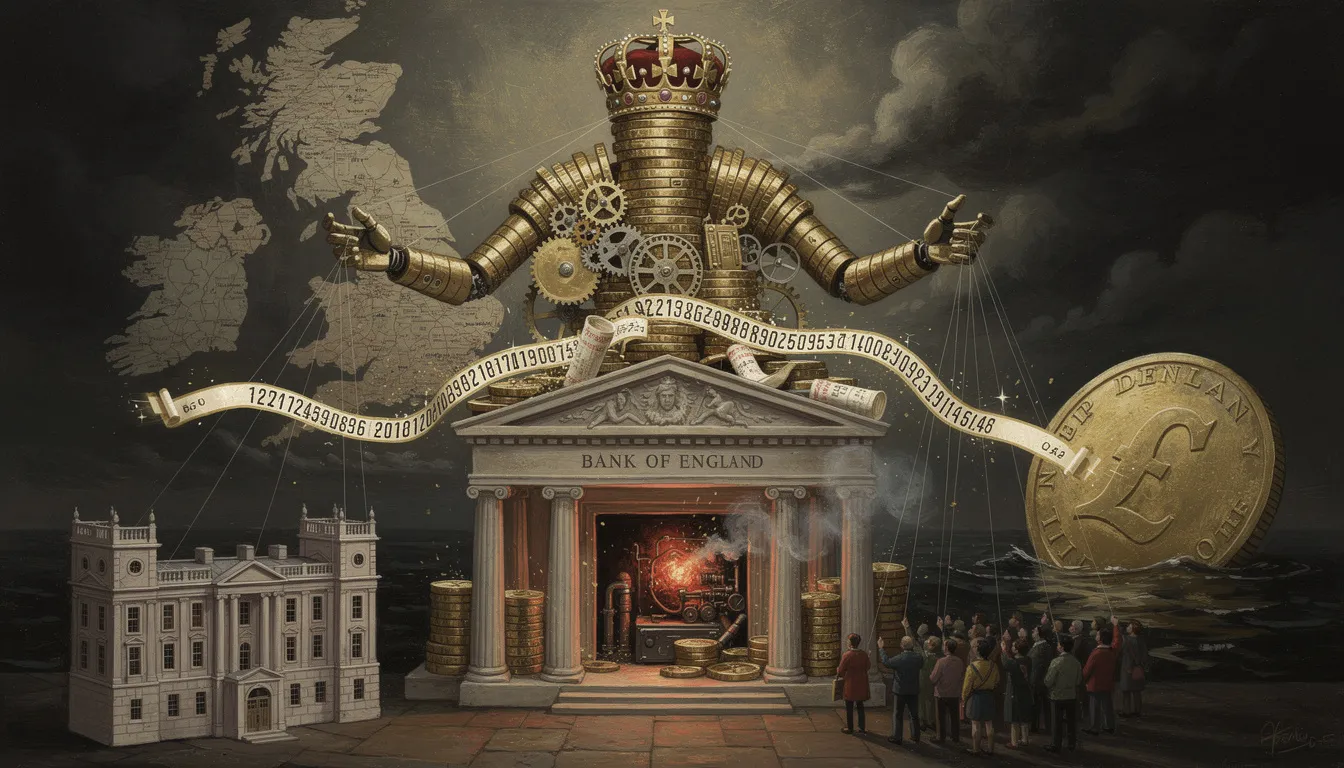
The Bond Market Is the Sovereign, or: How Britain Became a Rentier Colony
Sterling was the money of the world. Now it trades like an emerging-market currency. Trace the fall — from the Bank of England war debts to J.P. Morgan to Liz Truss — and you find not a nation in decline but a machine doing exactly what it was built to do.
Let me tell you who governs Britain. It is not the Prime Minister, and it is not the voters. In the autumn of 2022 a Prime Minister proposed a budget, and forty-nine days later she was gone — not because the electorate removed her, but because the market for government bonds refused it. The pound fell to $1.035, the lowest in its history. The Bank of England had to throw £65 billion at the gilt market in a single week to stop the country’s pension funds from collapsing. No one voted on any of this. The bond market vetoed a government, and the government fell.
Since then every British chancellor has governed with one eye on the same market, tightening budgets and shelving promises to keep it calm. This is not a scandal that happened once. It is the constitution of the country now. The bond market is the sovereign; elections choose the manager, and capital sets the budget.
How did the nation that ran the nineteenth-century world end up taking dictation from its own creditors? The usual answer is “decline” — a proud country that lost its empire, its industry, its confidence. That answer is a comfort and a lie. Britain did not simply decline. A machine was built, a long time ago, to turn money into more money without limit, and it has spent the last forty years doing exactly that — at the expense of almost everyone who lives here. The falling pound and the rising billionaire are not two stories. They are one machine, seen from both ends.
Who pays
Start with the people, because the abstractions are designed to make you forget them.
British real wages have not risen since 2008 — the longest period of pay stagnation in more than a century of records. Had pay simply continued its pre-2008 trend, the Resolution Foundation calculates, the average worker would be around £11,000 a year better off. Instead, real pay today sits roughly where it was in 2005. The National Institute of Economic and Social Research reports that the poorest households in Britain are now worse off than the poorest households in Slovenia and Malta. A nurse, a bus driver, a care worker has spent an entire adult working life running to stand still.
Now the other end. The number of British billionaires rose from 15 in 1990 to 156 in 2025. Together they hold £772.8 billion — more than the entire economy of Switzerland. According to analysis published alongside the Sunday Times Rich List, the fifty richest families now own more wealth than the poorest half of the country combined: thirty-four million people. The two richest Britons alone hold more than every billionaire on the 1990 list put together. And more than half of that billionaire wealth comes not from building anything but from property, inheritance, and finance — from owning, charging rent, and collecting.
The oldest money never even moved. As Guy Shrubsole documented in Who Owns England?, less than 1% of the population owns half of England; the aristocracy and gentry alone still hold around 30% of the land; ordinary homeowners own about 5%. The dukes are not heritage decoration. They are still, quietly, the largest landlords in the country.
Put the two ends side by side and the machine is naked. The share of national wealth held by the richest 1% was around 71% in 1900. It was squeezed down to about 16% by 1990. It is now climbing back past 21%. The privileged class is walking back to where it stood before the First World War.
The engine was always financial
To understand this you have to abandon the story you were taught, in which Britain was a nation of mills and mines and inventors. That Britain existed, but it was never where the power was. The power was in the City of London, and the City has now outlived the mills, the empire, and the currency itself — because it was never loyal to Britain. It is loyal to accumulation.
The Bank of England was founded in 1694 for a single purpose: to lend the Crown money to fight France. From birth, the British state and the City were fused around one product — government debt to finance war. Historians call it the fiscal-military state: Britain could out-fight larger, richer rivals not because of its factories but because the City could mobilise credit on a scale no absolute monarchy could match. Sterling ran the nineteenth-century world on the gold standard, but what stood behind sterling was the Royal Navy and the credit machine of the City — not the looms of Lancashire. Britain was the world’s banker and the world’s creditor. British power was financial before it was industrial, and financial all along.
The crown crosses the Atlantic
The First World War bankrupted the creditor. To keep fighting, Britain had to buy on an enormous scale from the one economy still selling — the United States — and it had to borrow to do it.
Enter J.P. Morgan & Co. In January 1915 Morgan was appointed Britain’s sole purchasing agent in the United States, buying some $3 billion of munitions, steel, cotton, chemicals, and food on Britain’s behalf at a 1% commission, and in October 1915 organising the Anglo-French Loan — $500 million, the largest private loan raised in America to that point. Financial primacy crossed the Atlantic in the First World War, not the Second. Britain went from the world’s creditor to America’s debtor, and it was the House of Morgan, not the City, that now underwrote the war.
The Second World War merely finished the job by a different route: “cash and carry,” then Lend-Lease from 1941, and the forced fire-sale of British overseas assets, leaving the country effectively bankrupt by the end of 1940 and dependent on a 1946 American loan it did not finish repaying until 2006. The Bretton Woods conference of 1944 then wrote the demotion into the architecture of the world: the US dollar became the anchor of the monetary system, and sterling was reduced to a junior reserve currency managing a shrinking club of former colonies. By every conventional measure, the City’s century was over. But capital does not retire; it relocates.
The second life: recycling the world’s dollars
Here is the move that tells you what financial capital actually is. Stripped of empire and outrun by New York, the City did not fade into a genteel retirement. It reinvented itself as the offshore banking centre of the entire world.
Through the 1950s, dollars were piling up outside the United States — Soviet dollars parked in Europe to escape American asset freezes, then the flood of dollars from the Marshall Plan and American deficits. These dollars needed somewhere to live, and London made itself that somewhere. Midland Bank took the first major deposits of these “Eurodollars” in 1955. When the 1957 sterling crisis forced the Bank of England to restrict the use of the pound to finance trade, London banks simply switched to financing the world’s trade in dollars instead. And crucially, the City treated these deals as “offshore” — a legal fiction in which a transaction done physically in London was deemed to have happened, in effect, in international waters, beyond the reach of both American regulation and British exchange controls. American banks were shackled at home by interest-rate caps and reserve requirements. London had neither. So the world’s dollars came to London precisely to escape the rules.
The market exploded — from roughly $3 billion in 1963 to $264 billion by 1969, and into the trillions by the 1980s. After the 1973 oil shock, the City became the great engine of “petrodollar recycling”: the oil exporters’ vast dollar surpluses were deposited in London and lent onward to the developing world, building the pipeline that would detonate as the Third World debt crisis of the 1980s. The “Big Bang” deregulation of 1986 sealed the reinvention.
The lesson is exact. London did not decline into irrelevance. It stopped being Britain’s banker and became global capital’s engine room — precisely as the British industrial economy was hollowed out beneath it. The City came to serve capital in general, and capital in general no longer needed Britain to make anything. The dealing rooms opened as the mills closed. Those are not two events. The offshore turn is the deindustrialisation, seen from the winning side — and the deindustrialisation is the wage stagnation, seen from the losing one.
Finance disciplines the state
Once finance is the master and the nation is merely its platform, the old relationship inverts. The state no longer commands finance. Finance polices the state.
The demonstration came in September 1992. Britain had pegged the pound inside the European Exchange Rate Mechanism at a rate its economy could not sustain. George Soros and the markets saw the contradiction and bet against the Bank of England; on 16 September the Bank spent billions trying to hold the line and lost, forced out of the ERM in a single day. Soros cleared around $1 billion. The point was never the trading profit. The point was the lesson: private capital can overrule the sovereign’s monetary word whenever that word is built on a contradiction.
Then the discipline became permanent. The gilt market — the market for British government bonds — settled into its role as standing watchdog over elected government, and 2022 showed what that means in practice: a budget vetoed in forty-nine days, a currency at its all-time low, a central bank forced into emergency intervention to save the pension system from the consequences. By 2025 and 2026, with thirty-year gilt yields near 6% — the highest since 1998 — and sterling described by currency strategists, without irony, as trading “like an emerging-market currency,” the pattern was routine. Every gilt auction now sets the ceiling on what an elected government may spend. Chancellors tighten budgets to reassure investors before they do anything for voters.
Notice what a weak currency actually does, because you are told to experience it as a vague national embarrassment. It is nothing of the kind. Britain imports its food, its energy, its medicine. When the pound falls, all of it costs more — and that price is paid hardest by the people who spend every penny they earn. A falling currency is a wage cut administered through the exchange rate. Meanwhile the class that owns land, shares, and dollars offshore is hedged or enriched, because a devaluing currency is exactly the moment it pays to own hard, scarce, un-inflatable things. The pound’s fall is not a loss the nation shares. It is a transfer, from those who earn to those who own.
The machine
Why does this system behave as though it had a will — grabbing, expanding, defending itself, refusing to stop? Because, in a sense that is more than metaphor, it does. And the person who described it most precisely was writing in 1867.
In Capital, Karl Marx defined capital not as a pile of money but as a process — value set in motion to become more value, with no built-in stopping point. He called the capitalist “capital personified and endowed with consciousness and a will,” and insisted that “use-values must therefore never be looked upon as the real aim of the capitalist… The restless never-ending process of profit-making alone is what he aims at. This boundless greed after riches…” The money, once thrown into circulation as capital, “assumes an automatically active character”; it “expands spontaneously”; its expansion “is automatic expansion.” Marx’s phrase for it, in the German, was the automatic subject — value that has become a self-moving thing with its own aim, using human beings as its organs.
And the human owner is not the author of this. He is its instrument. “Accumulate, accumulate! That is Moses and the prophets!” Marx wrote — and then explained why even a reluctant capitalist must obey: “competition makes the immanent laws of capitalist production to be felt by each individual capitalist as external coercive laws. It compels him to keep constantly extending his capital, in order to preserve it.” Read that last clause slowly. Extend it in order to preserve it. The system expands because standing still means being destroyed. The capitalist, Marx says, is “but one of the wheels” of the mechanism.
Here is what should stop you. Computer scientists who study how to build safe artificial intelligence describe their nightmare in the vocabulary of Capital. Give a powerful optimiser one open-ended instruction — maximise this quantity, no upper limit — and, whatever the quantity is, it converges on the same behaviours: it acquires resources, because resources help with any goal; it protects itself, because it cannot achieve its goal switched off; it resists having its goal changed; and it removes obstacles, including the people who set it running. Now look at capital’s instruction — turn money into more money, with no stopping point — and all four behaviours are already there, and already named, in Capital: the resource-grabbing of enclosure and empire, the self-preservation of “extend it in order to preserve it,” the co-opting of every reform that tries to make it serve need instead of profit, and the demolition of anything that stands in the way. Marx wrote the AI-safety paper a century and a half early. He just called the runaway optimiser capital, and its off-switch democracy.
This dissolves a tired argument. Is the reconcentration of wealth a conspiracy of the rich, or is it the impersonal logic of the system? It is both, and the two are not in tension. The conspiracy is real and documentable — the think-tank networks, the offshore trusts, the revolving door between the City and the Treasury, the captured tax code. These are the machine’s hands; it has no fingers of its own and acts through conscious, coordinating, richly rewarded people. And the impersonal structure is real too — competition forces even a decent owner to accumulate or be destroyed, so the drive survives any individual and reappears in any form. The structure operates through the agents, and rewards them for it. Which is why “it’s just the system, no one is to blame” is itself the machine’s alibi, spoken through its beneficiaries. The people running it are not suffering. They are collecting the yield and buying the politicians, and they will fight to the death any attempt to change the instruction, because the instruction is making them rich.
Why this is the system working, not failing
The most dangerous thing you will be told about all this is that the system is broken — that with the right rules and a little more growth, markets will behave and fairness will return. This is the reformer’s promise, and it is more useful to the machine than any honest defence of it, because it keeps you believing a better manager can fix what is not a malfunction.
Consider the years everyone remembers as fairer: roughly 1945 to 1980, the age of council housing, strong unions, and a currency people trusted. That period was not the system working properly. It was the system held down by force — by a war that had flattened old fortunes, by unions that could shut a factory, by taxes the rich could not dodge, by capital controls that kept money from fleeing. Once those restraints were dismantled — the unions broken, the tax code hollowed, capital set loose to roam the world — the machine simply resumed. It is not malfunctioning now. From its own point of view it malfunctioned for thirty-five years, and it has spent forty correcting the error. The reconcentration toward 1900 is not a bug. It is the machine, restored to factory settings.
What can be done
You do not persuade an engine to be kind. You either bolt restraints back onto it, or you change who owns it and what it is for. Everything else is watching it walk back to 1900 with a sympathetic expression. There are two tracks, and they must run at once.
Put the restraints back on — now. These buy real relief for real people while the deeper fight is fought, and the perfect must not be made the enemy of the better. Tax what cannot flee: land and buildings cannot be moved to Jersey, and a serious land and property tax, a wealth tax on the largest fortunes, capital gains taxed like wages, and the dismantling of the trust-and-shell offshore system would raise tens of billions from people who currently pay a smaller share of their wealth than the cleaners who service their offices. Rebuild the workers’ hand: wage stagnation tracks the collapse of union membership almost exactly, and sectoral bargaining with real enforcement is the most direct lever there is. And take the necessities out of the casino: public housing at scale, and public ownership of the energy and water systems whose price spikes are the cost-of-living crisis. What people cannot live without should not be someone’s profit centre. These restraints will be fought, and they can be stripped off again the moment attention wanders — that is not an argument against imposing them, only against mistaking them for the cure.
Change who holds the controls — this is the part that lasts. Restraints get stripped off again the moment the many look away; that is the lesson of 1980. The durable move is to shift ownership itself: worker-owned enterprises, so the surplus a workplace produces stays with the people who produced it; public and cooperative banking that directs credit toward production and homes rather than bidding up the assets the rich already hold; and, alongside the fight over the state, the patient building of alternatives — community energy, tenants’ unions, mutual credit, cooperative food — so that every necessity people can meet for themselves becomes one less lever the machine holds over them. The aim is to be able to say, and mean it: we do not need you.
The honest bottom line is that the first track slows the machine and feeds real people tomorrow, while only the second changes the instruction it runs on — from make money without limit, for whoever owns to produce what people actually need.
The safety researchers have a thought experiment about a machine given one careless order — make as many paperclips as possible — that ends by consuming the world to obey it. We do not have to imagine it. We already have a machine that turns everything it touches into rent, that fights anyone who reaches for the off-switch, and that has just made itself sovereign over a G7 democracy. It is not coming. It arrived with the enclosures, and it is wearing a top hat.