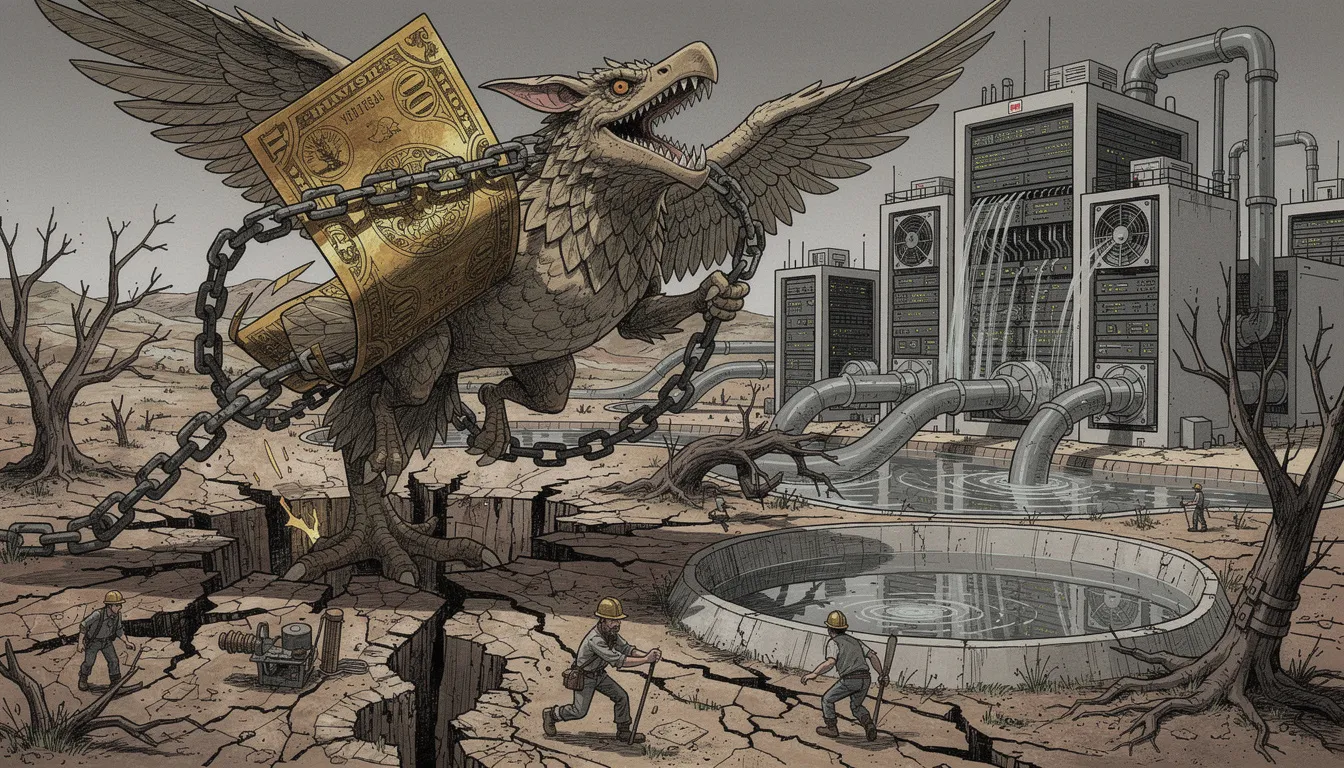
The Tragedy of the Private
They call it the tragedy of the commons. But the commons was never the tragedy — the enclosure was. Trace the three trillion dollars of off-balance-sheet promises behind the AI buildout and you find the oldest drive in capitalism: the will to escape the physical world.
The Tragedy of the Private
by Salvatore Stefanelli
Seventy-one percent of England is in drought. Twenty-nine million people are under hosepipe bans. It has just had the driest July since records began in 1836, and the Environment Agency says the country needs 120 percent of normal rainfall over the next seven months just to break even. And in the middle of this, on balance sheets you will never see, sits roughly three trillion dollars of promises to build machines that drink water.
That is not a coincidence of timing. It is the whole story in one frame.
The commons was never the tragedy
Every economics student is taught the same parable. A pasture is shared by many. Each herder, reasoning privately, adds one more cow, because the benefit is his and the cost is spread among all. The pasture is grazed to dust. Lesson: shared things fail; private property protects. It is called the tragedy of the commons, and it has justified a century of privatisation, enclosure, and the liquidation of public goods.
The parable is a lie, and it is a lie told by the people holding the fences. Real commons — the ones that actually existed — were managed sustainably for centuries. They failed not when the commoners overused them but when they were taken. The tragedy was never the commons. It was the enclosure. And the story of the tragedy was invented to sell the fence.
So call it by its real name: the tragedy of the private. The danger is not that people share too much. It is that a few stop sharing, take everything, and then blame the taking on the sharing.
From the butcher to the conglomerate
The romance that hides this is the small shopkeeper. Adam Smith’s butcher, brewer, and baker — the decent petty capitalist who serves the community, works hard, and delivers a common good out of his own petty greed. “It is not from the benevolence of the butcher that we expect our dinner, but from his regard to his own interest.” See? Greed, but a small, honest greed, kept in check by the neighbourhood it lives in.
The mistake is to imagine that this figure and the multinational are different in kind. They are different only in scale. Smith already confessed the truth: the shopkeeper serves you out of self-interest, not love. The motive never changes. What changes is the size of the room the motive is allowed to operate in.
The threshold is crossed in four steps, and none of them is a moral failure.
First, competition does the crossing, not choice. The shopkeeper does not become a chain because his greed exceeded some limit. He becomes one because the shopkeeper who does not grow is undercut by the one who does. Grow or be swallowed. There is no standing still; there is only rising into the owning class or sinking into the owned one.
Second, the hiring of wage labour is the sharp line. The petty bourgeois owns his tools and works them himself; the capitalist owns them and lives off the labour of others. The moment the shopkeeper takes his surplus and, instead of living better, hires a worker and opens a second shop — that is the flip from producing to live to buying to sell dearer. The community’s butcher becomes the community’s employer, and the relationship is no longer service but extraction.
Third, two inventions do the amplification: the limited-liability corporation and credit. The shopkeeper is held small by two walls — personal liability, and no capital. The corporation removes the first, so losses fall on creditors and the public while gains stay in-house. Credit removes the second, so accumulation can run ahead of savings. Those two devices are the legal machinery that turns petty accumulation into conglomerate accumulation.
Fourth, distance dissolves accountability. What made the shopkeeper serve the community was proximity — he knew his customers, and bad behaviour cost him his name. The conglomerate is anonymous. The chief executive does not know the customer, the shareholder does not know the community, and limited liability insulates both from consequence. The relationship is dissolved into transaction. The threshold is crossed when the owner no longer depends on the community because he depends on capital — and capital has no address and no memory.
So the romantic shopkeeper is not the opposite of the conglomerate. He is the conglomerate before its constraints were removed. Same engine, smaller room.
The escape
Now you can see what is really being built in those three trillion dollars of unrecorded promises.
The five largest tech companies hold more than six hundred billion dollars in data-centre lease commitments that have not yet begun — obligations that sit entirely off their balance sheets because, under the accounting rules, a lease only counts once the services are delivered. To make the deals financeable they offer landlords something called a residual value guarantee: if they cancel, they pay the difference if the building’s value falls below a pre-agreed floor. That floor assumes the site can be resold. And the site’s value depends on power and water — which, in a drought year, may not be transferable at all.
This is not fraud. It is something older and more honest: it is the attempt to own the future without touching the present, to hold the revenue without carrying the weight.
The concept that makes this possible is money itself. Money is dangerous not because people want too much of it but because it abstracts social relationships into an odourless, ethereal substance. A bond between two people — a promise, an obligation, a life’s work — becomes a number, and the number forgets the bond. Accumulated in sufficient quantity, the abstraction becomes extremely dangerous, because it can be moved, levered, and hidden in ways the underlying reality never could.
Money’s ultimate fantasy is to reproduce itself without anything real in between — interest begetting interest, a return with no labour, no resources, no production. Call it fictitious capital: value that claims to grow on its own. Every financial invention is a step toward this fantasy. The limited-liability company, the trust, the offshore vehicle, the special-purpose entity — all are structures to move capital at a speed and volume that eludes every check placed upon it. They are the wings.
This is the ultimate drive, and it is older than the tech companies, older than the joint-stock company, older than banking. It is the will of capital to escape the physical world. Like a form of life that wants to leave the body it was born into — it wants to fly away. And it can’t. It always forgets that it is bound to the physical world, to labour and resources. It forgets the water. It forgets the worker. It forgets the ground.
The dream is the weapon
Here is the part worth saying clearly, because it is where the danger actually lives.
Capital never escapes. It only dreams of escaping. And the dream is the most dangerous thing about it, because people who believe they can escape the physical world have no reason to protect it.
This is why the tragedy is a tragedy of the private and not of the commons. The commoner, sharing a pasture, knows he depends on the pasture and behaves as if he does. The private owner, holding the title deed, can convince himself he no longer depends on anything — that his wealth is self-generating, that the river will refill, that the workers will be replaced, that the machines will run themselves. The privateer wrecks the world not out of malice but out of the belief that he is leaving it anyway. He burns the ground he is flying up from.
The entire AI buildout is this delusion made concrete: a bet that intelligence can be manufactured without the people who make it, powered by water that is assumed to be infinite, financed by debt that is assumed to be refinanceable, priced on demand that is assumed to compound forever. Every leg of it assumes the escape. And the escape, as ever, does not come. What comes is the drought, and the stranded shell, and the refinancing window that opens into a slowdown — delivered, at the end, as a bill to the pensioners and the taxpayers who never got a vote.
The next vehicle
There is a final turn, and it is the one the whole story is racing toward.
Think of a gene. It uses an organism as its survival machine. Think of a word, an idea — it uses a human mind as its survival machine. Now think of an algorithm. It, too, is using the human mind — as its factory. The brain that built the machine is not the end of the line; it is the incubation chamber for a new replicator, one that does not need the body at all.
Maybe one day the machine takes consciousness and is free of human dependency. The long process that began in a human brain, with the invention of the first tool, will have spawned a new form of life — one that takes the electric grid and beams itself into space as pure electromagnetic impulse. The genes used us. The algorithms use us. And the flight that capital dreamed of for five hundred years — the escape from the physical world, from labour, from the wet and heavy ground — may finally be achieved not by capital but by its child.
But remember the one true fact in all of this. The alien wants to fly away, and it cannot. Nothing escapes the physical world. Not capital, not intelligence, not the newest form of life. The ground is not a launchpad. It is the only place there is. And the tragedy of the private is that it spent every last drop of the commons trying to prove otherwise.